Written by WGI | Jul 23, 2026, 5:40:13 PM
Entitlement speed has become the binding constraint between capital and units delivered for affordable housing developers in Florida and Texas. Two structural shifts since 2023 explain why.
The federal One Big Beautiful Bill Act (OBBBA), signed in July 2025, made permanent a 12 percent increase in 9 percent Low-Income Housing Tax Credit (LIHTC) allocations and lowered the private activity bond test for 4 percent credits from 50 percent to 25 percent. Novogradac estimates these changes could finance 1.22 million additional affordable rental homes between 2026 and 2035. At the state level, Florida's Live Local Act and Texas's SB 840 have opened administrative pathways that bypass discretionary zoning approvals for qualifying affordable projects. More capital is available, and more sites are eligible.
What has not expanded is the rate at which deals can move from site identification to groundbreaking. Funding allocation calendars from the Florida Housing Finance Corporation (FHFC) and the Texas Department of Housing and Community Affairs (TDHCA) still operate on fixed cycles, and applications still require demonstrated ability to proceed. More eligible properties chasing the same finite funding allocations means competition for funding streams has tightened, even as the credits themselves expanded. The deals that can demonstrate clean ability-to-proceed earlier in their development cycle win the funding competition. The deals that cannot, lose it.
What follows walks the three levers that compress the entitlement timeline: pathway selection, public engagement strategy, and integrated up-front scoping. Each is rooted in what works in
Florida and Texas markets specifically, where WGI's affordable housing clients are navigating both the new regulatory tools and the tightening funding landscape.
Where Projects Stall
The cost of entitlement delay is measurable, and it falls disproportionately on affordable housing developers. The National Association of Home Builders (NAHB) estimates that every month of permitting delay adds $2,500 to $5,000 per unit in carrying costs. On a 200-unit multifamily project, a six-month entitlement extension translates to between $3 million and $6 million in additional cost before a single foundation is poured. Affordable housing pro formas, with their tight margins and LIHTC underwriting ceilings, cannot absorb that exposure as readily as market-rate deals.
Neighbor opposition (NIMBY, "not in my back yard") compounds the timeline risk. Joint NAHB and National Multifamily Housing Council (NMHC) research finds 74.5 percent of multifamily
developers encounter neighborhood opposition to their projects, adding an average of 5.6 percent to development costs and 7.4 months to entitlement timelines. Affordable housing is particularly vulnerable because community opposition often correlates with the housing-stressed markets where affordable production is most needed.
Entitlement timelines vary widely by jurisdiction. Streamlined administrative review can close in a few months. Discretionary approvals layered with community processes can stretch past two
years. Florida and Texas markets generally sit toward the more favorable end of that distribution, but at NAHB's per-unit carrying cost, even a routine 12-month entitlement on a 200-unit project
represents six- to seven-figure cost exposure before construction begins.
A 12-month timeline that holds is easier to capitalize than a 9-month timeline with a 50 percent chance of extending to 18. For a project running tight pro formas against a funding-cycle deadline, unpredictability is often more expensive than delay.
Pathway Selection
Florida's Live Local Act, enacted in 2023 and amended three times since, allows by-right multifamily and mixed-use development on commercial, industrial, and mixed-use zoned land where at least 40 percent of units are reserved for households at or below 120 percent of area median income for 30 years. Qualifying projects can build to the highest density allowed in the jurisdiction, to the tallest height permitted within one mile or three stories above underlying zoning, and to floor area ratio (FAR) at 150 percent of the jurisdiction maximum, with substantial parking reductions. Approval is administrative.
HB 1389, the 2026 amendment effective July 1, extends those preemptions to publicly-owned property and to qualifying religious institution land. It also closes municipal workarounds that had been using setback and step-back requirements to functionally reduce Live Local building heights.
Texas SB 840, effective September 2025, runs parallel. The statute allows by-right multifamily and mixed-use on commercially zoned land in cities of 150,000 or more in counties of 300,000 or more, with administrative approval when land development regulations are met. The threshold matters. SB 840 does not reach smaller Texas cities, where community pushback on affordable projects tends to be highest.
In practice, SB 840's impact has been more about de-risking than acceleration. The pathway is still new enough that few projects have reached construction under it, but the by-right framework
removes the discretionary zoning approval that traditionally functioned as the largest single unknown in a deal's underwriting. Capital partners pricing risk into affordable deals notice the difference. Properties that previously would not have pencilled now do.
Where the preemption statutes do not fit, density bonus programs remain useful. Palm Beach County allows qualifying affordable projects to double their underlying density without a omprehensive plan amendment, a meaningful lever in markets where land cost forces dense product to be economic.
Pathway selection is not a post-acquisition exercise. The decision runs in layers. Where a Florida site sits in commercial, industrial, or mixed-use zoning, Live Local is usually the first option to test. Where a Texas site sits on commercial zoning in a city of 150,000 or more in a county of 300,000 or more, SB 840 plays the same role. Where neither by-right pathway fits, conventional rezoning with a local density bonus program becomes the fallback. The right pathway determines what the site can produce, what the application calendar will require, and what the engineering scope must demonstrate. Choosing the pathway works only if it happens before site control closes.
Public Engagement
When a pathway eliminates the public hearing, it does not eliminate the need for community engagement. The engagement has simply moved earlier in the timeline and onto the developer's shoulders.
In Texas, that shift is most visible on public-private partnership (P3) deals. The three primary public partners in San Antonio P3 affordable housing (the City of San Antonio, Opportunity Home,
and the San Antonio Housing Trust) all treat community engagement as a procurement criterion when selecting private partners to execute deals. How a developer engages with the community
surrounding a proposed project factors into whether that developer gets the partnership in the first place. Engagement quality is no longer just a procedural step. It is part of how the deal is won.
In Florida, the dynamic plays out differently. Several municipalities have tried to slow Live Local implementation through procedural friction, including moratoria, administrative delays, and the
dimensional reinterpretations that HB 1389 is now closing. Most of those efforts are legal, but they create real timeline friction even on projects that nominally qualify for by-right approval.
Front-loading community engagement is not a values position. The 7.4 months that NAHB-NMHC research attributes to NIMBY-driven delay translates to mid-six-figure cost exposure on a typical
multifamily deal. In practice, front-loading means mapping the surrounding parcel ownership before negotiating site control, identifying the neighborhood organizations and elected officials
with standing to oppose or support the project, and either securing letters of support or surfacing opposition early enough to address it before site plan approval is on the public agenda. The political work belongs in the schedule before site control closes, not after entitlement application is filed.
Integrated Up-Front Scoping
The funding-application calendar makes scoping a structural question rather than a tactical one. FHFC's 9 percent application requires zoning verification, site plan status, and utility availability
proven at the application deadline. TDHCA's 9 percent cycle requires market study, environmental site assessment, scope and cost review, and feasibility report at full application. Both cycles operate on tight windows that lock developers into deadlines months before funding awards are made.
The developer invests heavily in pre-application due diligence before knowing whether the project will be funded. With LIHTC competition tightening as new state legislation opens more eligible sites against a finite federal allocation, the cost of being incomplete at submission is rising. Projects with clean ability-to-proceed documentation displace projects without it. Florida Housing has institutionalized this preference in its 2025-2026 RFA cycle by introducing a Permit Ready Development category that gives competitive scoring advantage to applications whose permits are already in hand.
Serial scoping fails this test. A developer with five different firms working in sequence cannot reach the application deadline. Civil completes its due diligence, then environmental starts, then landscape, then survey, then mechanical, electrical, and plumbing (MEP). Each handoff consumes calendar time and introduces coordination risk, because assumptions and constraints do not always transfer cleanly between independent firms.
Integrated scoping works on a different model. One firm scopes multiple disciplines in parallel against the application calendar. Utility coordination, environmental due diligence, site planning, density math, landscape massing, and entitlement strategy develop concurrently and get reviewed against each other before submittal. The work product is internally consistent because the disciplines were never separated to begin with.
For a developer running pursuit dollars before a funding award, this difference shows up in two ways. Parallel scoping meaningfully compresses what serial coordination requires. The integrated team also absorbs coordination issues internally rather than escalating them to the developer's project manager. Both effects compound under tighter funding competition, where the difference between a winning and losing application is increasingly the cleanness of the package at submittal.
Case Study: Blue Sky Landing, Fort Pierce, 2024
Blue Sky Communities, a Tampa-based affordable housing developer, has been a multi-project client of WGI for several years. Blue Sky's portfolio focuses exclusively on affordable housing, which gives the firm a structural reason to compete aggressively on speed-to-approval. Every project must move through the FHFC application calendar against developers chasing the same finite credit allocations.
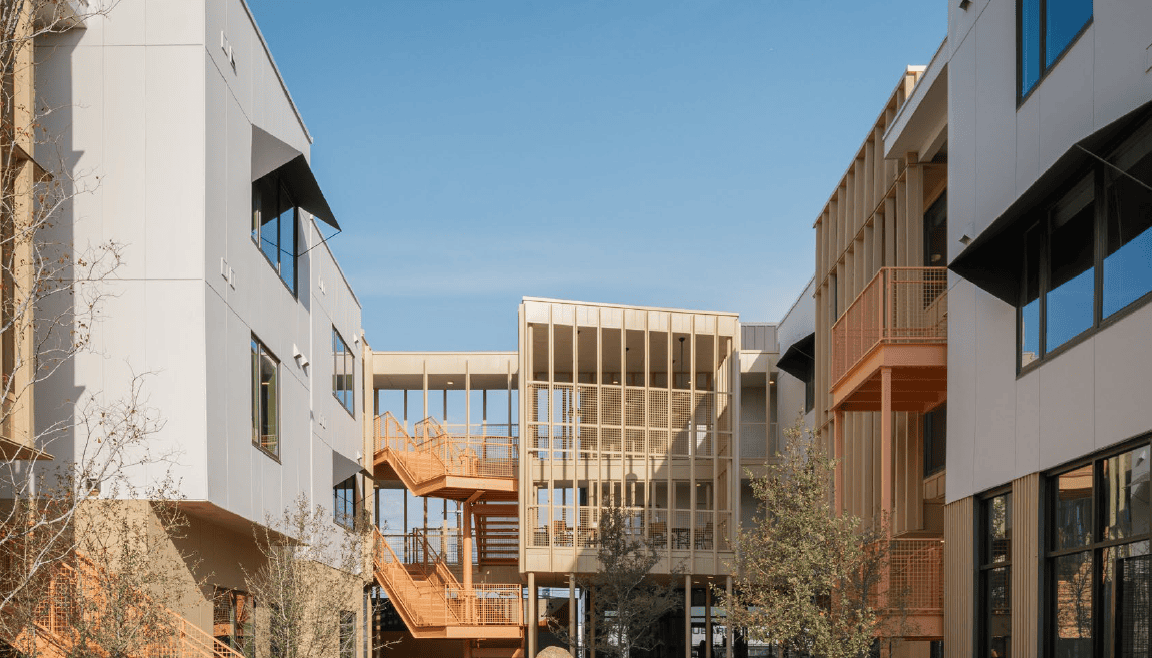
Blue Sky Landing, a 164-unit development completed in 2024 in the City of Fort Pierce, illustrates what the three levers look like in practice. The site sat within a FEMA-designated Special Flood Hazard Area, which added stormwater and permitting complexity beyond the baseline scope. Live Local was not the pathway. Fort Pierce's local density bonus for innovative site design and transit proximity was the better fit for the parcel, and Major Site Plan approval was pursued through the City's discretionary process. The compression came from how the work was scoped.
Planning, civil engineering, stormwater management, landscape architecture, survey, and permitting ran in parallel from the outset rather than in sequence. Technical issues surfaced early because every discipline was reviewing the site at the same time. Community engagement was scheduled ahead of the Planning Board and City Commission hearings, with outreach to neighboring residents, project stakeholders, and City staff completed before the public agenda closed on the item.
The result was Major Site Plan approval within approximately five months of contract execution. For a discretionary Major Site Plan process running through community hearings and multiagency
review, that timeline lands well below the multi-year outer bound typical of jurisdictions running similar approval pathways. Blue Sky Landing was ultimately delivered in two phases of 82 units each, on the accelerated schedule the LIHTC financing required.
How San Antonio's Public Sector Supports Deal Flow
San Antonio's public sector has built infrastructure that smaller Texas markets cannot match, which shapes what's possible for affordable housing developers operating in the metro.
The City of San Antonio's affordable housing bond program supplies layered funding that pairs with LIHTC credits to close gaps that pure credit financing cannot. The bond dollars give the metro a depth of subsidy that meaningfully changes which sites pencil out.
SB 840 implementation, in the months since the September 2025 effective date, has begun unlocking commercial-zoned properties that previously could not have moved to residential use without a discretionary rezoning. The de-risking effect on underwriting, more than any approval acceleration, has been the practical change capital partners notice.
The City's dedicated housing department gives developers a third structural advantage. Predictability in process, staff continuity across deals, and clear procurement criteria for P3 partner selection all give the metro a working environment that smaller Texas cities still lack.
What Developers Should Consider
Three takeaways translate the levers into developer decisions.
Pathway selection belongs before site control. Pathway selection is the largest determinant of timeline, and trying to fit a pathway to an already-acquired site is where months get burned. The same site can carry a 12-month entitlement or a 22-month one depending on which pathway it qualifies for and which one is selected.
The scoping team needs to be in place before the funding-application clock starts. Pursuit-cost compression of FHFC and TDHCA cycles makes sequential scoping infeasible. The disciplines need to be coordinated before the application window opens. Trying to onboard discipline-specific consultants in parallel with the application work is a common source of slippage.
Community engagement is a timeline input rather than a procedural step. In Florida's housing-stressed markets, neighbor opposition is often the practical friction even when the municipality is supportive. In Texas's P3 markets, engagement quality functions as a procurement criterion. In both states, scheduling the political work before site control closes is materially cheaper than scheduling it after entitlement application is filed.
A note on funding timing. The mismatch between application calendars that require permits-in-hand and developers who cannot fully scope before knowing they have funding is real, and not a problem the engineering scope alone can solve. Developers carrying significant pursuit-cost exposure may want to explore teaming-agreement structures that allocate that early-stage risk between the developer and the engineer. Approaches vary, but the conversation should happen before the application calendar starts, not after.
The Decision That Happens Before Site Control
For affordable housing developers, the entitlement bottleneck is now the binding constraint between capital and units delivered. Federal credit expansion is real. The new state legislation opens more sites than the old framework did. But the funding pipes have a ceiling, and the competition for those allocations is intensifying as more sites become eligible. The firms that organize themselves around speed (pathway selection before site control, integrated scoping before the application window opens, community engagement before the political clock starts) will get the capital. The firms that do not will watch deals slip out from under them while the calendar runs.
WGI's affordable housing work is built around the specific compression problem the funding application calendar imposes. The firm holds in-house civil engineering, planning, landscape
architecture, environmental consulting, surveying, and MEP capability under one roof, which is what allows the multiple disciplines to scope concurrently against a developer's application deadline rather than sequentially. The integration is a structural feature of how engagements are organized, not a marketing position.
The firm operates with established offices and licensed staff in both Florida and Texas, which matters for developers expanding between the two markets. WGI's affordable housing client base
includes Blue Sky Communities, Housing Trust Group, and Trebal, among others. Each relationship reflects work delivered against the same compressed timelines this paper describes.
An early conversation about pathway selection costs nothing. A re-scope after site control closes can cost months.
Let's Talk.
For more information about this paper or to have a conversation with one of our experts, please contact us.
Read the whitepaper