.png?width=185&height=175&name=WGI%20Icon_Green%20(1).png)














This article appeared in the December 2017 issue of Parking Today. Click here to view the article.
by Gary Cudney, PE
That provocative headline grabbed your attention, but our industry must admit that we do not yet know all the questions — let alone the answers — about autonomous (AV) and shared vehicles. Certainly, the No. 1 question that parking professionals ask is, “How will it impact us?”
I wish I had the definitive answer to that question alone.
We are still at a point where media coverage about the coming age of autonomous vehicles is more opinion and speculation than hard facts. This dialogue is complicated by the extent of autonomous features under consideration.
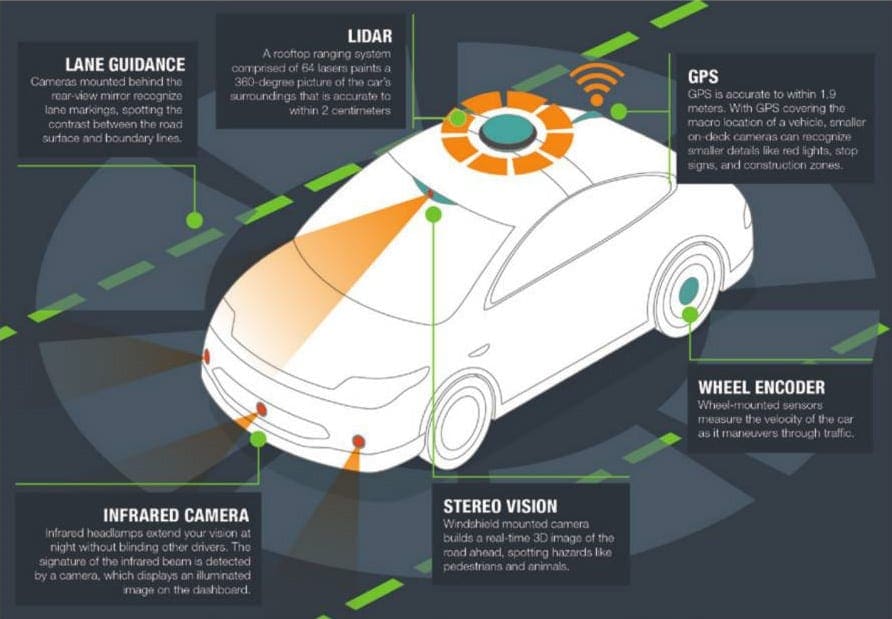
Already, many vehicles have semi-autonomous driver assistance features (Level 1 and 2), such as adaptive cruise control, driver-attention monitoring, lane-departure warning, and parking assist. However, going from semi-autonomous to limited self-driving automation (Level 3), or to full self-driving automation (Level 4) are major leaps over current technology.
Yet, it seems many speakers and writers are stating that full self-driving AV is an imminent fact, rather than an opinion.
That said, I will share my two cents here in Part 1 of this article, plus, in Part 2 next month, I will present an innovative approach to flexible parking structure design that we call FlexPark.
 I admit I am a skeptic of self-driving autonomous and shared vehicles, especially about how soon they will become a disrupter to the parking industry. However, as a parking consultant and designer of parking structures that have a 50- to 100-year life span, I must anticipate changes caused by AV during this timeframe.
Reasons for my skepticism include the many barriers to self-driving AV and shared-vehicle adoption. Understanding these barriers is key to predicting the speed and depth of impact their acceptance will have on the parking industry.
(Note: In the rest of this article, the focus will be on Level 4, fully self-driving AV that will have a dynamic impact on our industry and society at large.)
I admit I am a skeptic of self-driving autonomous and shared vehicles, especially about how soon they will become a disrupter to the parking industry. However, as a parking consultant and designer of parking structures that have a 50- to 100-year life span, I must anticipate changes caused by AV during this timeframe.
Reasons for my skepticism include the many barriers to self-driving AV and shared-vehicle adoption. Understanding these barriers is key to predicting the speed and depth of impact their acceptance will have on the parking industry.
(Note: In the rest of this article, the focus will be on Level 4, fully self-driving AV that will have a dynamic impact on our industry and society at large.)
I admit I am a skeptic of self-driving autonomous and shared vehicles, especially about how soon they will become a disrupter to the parking industry. However, as a parking consultant and designer of parking structures that have a 50- to 100-year life span, I must anticipate changes caused by AV during this timeframe.
Reasons for my skepticism include the many barriers to self-driving AV and shared-vehicle adoption. Understanding these barriers is key to predicting the speed and depth of impact their acceptance will have on the parking industry.
(Note: In the rest of this article, the focus will be on Level 4, fully self-driving AV that will have a dynamic impact on our industry and society at large.)
Barrier #1 – Technology
The technology itself is the greatest barrier to entry. AVs rely on both connecting to the vehicles around them, as well as to roadway monitoring sensors. Testing of AV has not progressed to highway speeds under extreme conditions of snow, ice, fog and heavy rain, and emergency conditions related to accidents, construction, or other unforeseen traffic conditions – all extremely important conditions to test and validate before implementation and adoption are feasible.
Seemingly easier technology issues to resolve are the AV’s ability to find open parking, enter with autonomous access control, and exit upon automatic payment. Once parked, autonomous electric-vehicle (EV) charging will also need to occur.
Barrier #2 – Governmental Regulation, Legal Issues, and Lobbyists
The governmental regulation process for AV is still a big unknown and includes federal, state and local governments. Added to that complexity are the myriad of legal and insurance issues. Tough questions will need to be answered, such as:- Who is at fault in the case of an accident by a self-driving AV?
- Should driverless AVs be programmed to always follow the law?
- How will AVs be programmed to respond to an emergency? Will they protect the vehicle passenger(s) first or choose to put them at risk in favor of others outside the vehicle?
- What will be the role of the federal, state and local governments to establish AV regulations?